The Cosmopolitan Elite
We've replaced the Middle Class, the bedrock of US prosperity, with a Cosmopolitan Elite. Here's what it means.

For the first time in America’s history, the top 10% of income earners account for ~half of all consumer spending, and the trend line points to more growth.
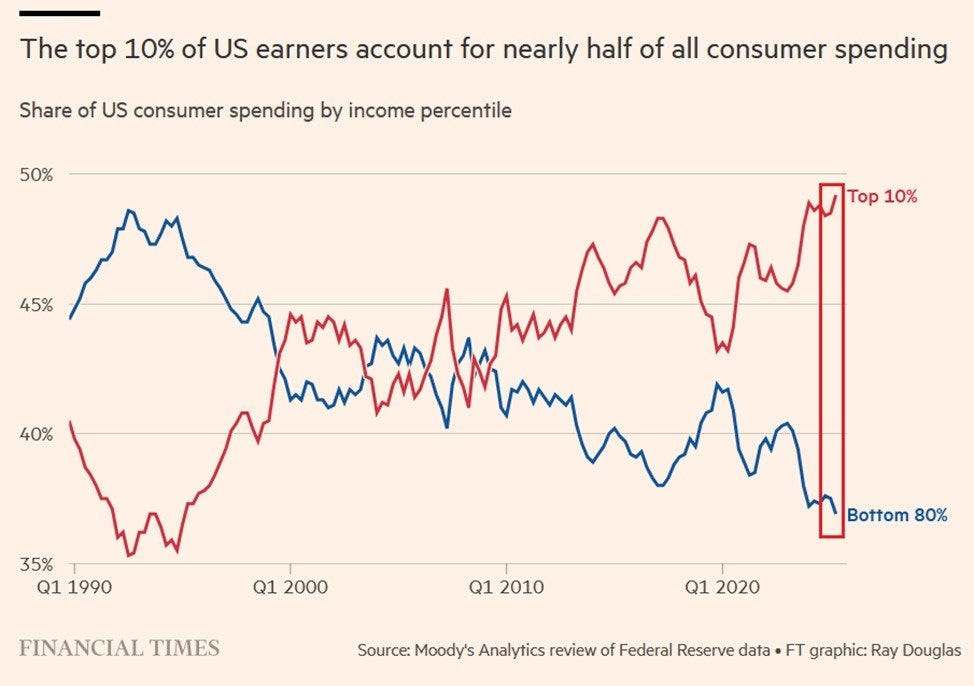
If you dive into the numbers, a picture forms;
The economic impact of the top 10% (25-30 m people) is far greater than that of the much more numerous middle class.
Its impact is increasing — the trend line since the financial crisis is solid.
Diving deeper, it’s also pulling away from the rest of the income brackets — relative to the median income, the threshold for inclusion in the top 10% is 50% higher today than in 1990, adjusted for inflation. Note: the current household-level threshold is $251,000.
Given how important the middle class has been to the US — economically, politically, and socially — since its founding (if we treat America’s exceptionally high number of landed farmers as a pre- and early-industrial middle class), its replacement by a small new ‘class’ is a monumental shift in the socioeconomic structure of America. To figure out what this means, let’s dig in.
“Over the last thirty years, rampant globalization and poor governance has replaced a thriving middle class (60% of the population) with a thriving cosmopolitan elite (10% of the population).”
The Role of the Middle Class
To understand what the loss of the middle class means, let’s frame what it provided. The middle class, and previously the landowning farmer, was always at the center of America (its only decline, in the early 1900s, led to a low point demarcated by the Great Depression).
Land ownership enabled the vast majority (80% of families at the time of founding) of Americans to both produce and accumulate wealth as farmers (90% of the population were farmers).
However, as farming declined due to productivity improvements, so did land ownership (down to 44% during the Great Depression) and with it the ability of the majority to accumulate wealth.
This was rectified after WW2 through the development of the modern middle class, driven by an expansion of home ownership (and to a lesser extent, corporate pensions). Ownership peaked at 69% in 2004 and has since declined to 65%.
What most people don’t appreciate is what happens when the majority of the population has access to a vehicle for producing and accumulating wealth.
The Capitalist mindset. As the historian Max Weber pointed out, land ownership led to a critical shift in mindset from serfs (in the rest of the world) who worked just enough to get by (needs + tithe to the lord who owned the land) to landowning farmers who worked extra hours and constantly innovated to improve their position. Features: Entrepreneurship. Risk-taking. Self-improvement. Saving and investing. Value hard work.
The first Mass Market. Until the founding of the US, only aristocrats and wealthy businessmen had discretionary income. That shifted when the US enabled millions of families to accumulate wealth. The scale of mass market spending power drove industrialization.
Rapid technological innovation. The mass market also changed the direction of technology. Technological development shifted from producing a small number of luxury items and weapons of war (what aristocrats wanted) to a wide variety of tools (for greater productivity) and labor-saving devices (aristocrats didn’t need these; people were cheap). Also, due to the shift in mindset (continuous self-improvement), the mass market was ready and willing to try new innovations, providing a feedback loop for entrepreneurial innovation (early adopters).
The Decline of the Middle Class
The decline of the middle class began with the end of the Cold War. During the Cold War, a thriving middle class was seen as essential to US survival, leading to policies designed to grow and strengthen it.
