The West's Achilles Heel
Immigration has become the West's greatest weakness due to a flawed decision making. Here's what went wrong and how to fix it.

There was an interesting example of weaponized migration this week.
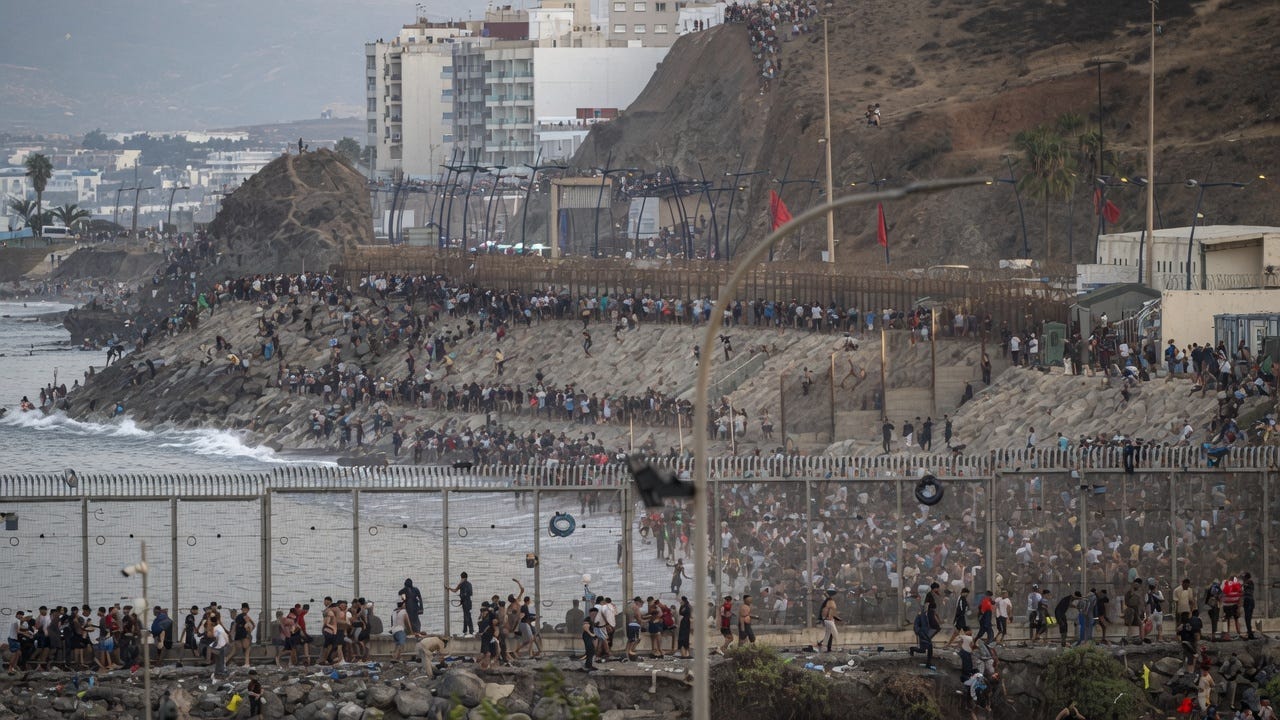
60,000 (NYTimes) ‘migrants’ flooded into Ceuta, Spain’s isolated territory in North Africa, over the course of 24 hours.
Given the logistical scale of the event, it was likely planned and supported by the Moroccan government to disrupt and coerce Spain, which Morocco wants out of North Africa.
This was the third time Morocco has used this tactic. In 2005, a thousand ‘migrants’ broke through. In 2021, 12,000 flooded in.
This tactic was particularly effective this year due to:
A migrant-friendly Spanish government and court made it possible to convince migrants they had a chance to stay in the EU if they broke through.
A mature networked insurgency focused on remigration quickly took the videos of the incident and turned them into empathy triggers depicting an existential threat.
Growing distrust and discord in the EU among member governments over immigration has led many governments, including Italy and France, to suspend or restrict Schengen with Spain.
This incident is another demonstration that immigration has become the West’s greatest weakness.
The West’s Achilles Heel
Migration has become the greatest political vulnerability of Western governments.
Angela Merkel’s (Germany) decision to suspend Dublin rules for a million Syrians in 2015 was the critical catalyst behind Brexit’s victory.
The Biden administration’s inability to control the US southern border, leading to 10 million-plus illegal entries, was a major factor in putting Trump into office again.
A constant flow of violent incidents involving migrants is providing the footage, stories, and narratives needed to fuel a thriving networked insurgency and new political factions focused on remigration.
What Went Wrong
The reason migration has become such a divisive and disruptive issue is flawed decision-making. Let’s dig in.
Novelty. For most of the West, mass migration is a new problem. New problems are harder to solve because experience doesn’t provide a template for solving them.
Historically, mass migration is warfare, leading to displacement or eradication. However, for the West, the last time that happened was nearly a thousand years ago.
In modern history, the West’s population grew so quickly that it was the source of migration (the biggest cities in the world in 1900 were London, New York, and Paris).
Only recently, over the last handful of decades, has this reversed, leading to unprecedented levels (again, novelty) of immigration (15-30%).
Unlike much of the West, the rest of the developed world has recent experience with colonization and foreign domination, and is therefore resistant to mass immigration. This decision has allowed them to provide income growth — 8x in China, 2.5x in Korea between 2000 and 2020; in contrast, the US during this period has been 0.1x — and domestic social stability during a period of extreme disruption.
Imbalance. The West has demoted key social decision-making processes, while promoting others. This has led to an imbalanced decision-making system.
Resilient social decision-making (since the dawn of modernity) has been a complex mix of market, tribal (nationalism), and institutional decision-making. Recently, we’ve added network decision-making to the mix.
The West has intentionally demoted tribal decision-making (tribal), eliminating its contribution to cohesion and coherence, and elevated market and institutional decision-making.
This imbalance has led to the rise of faddish ideologies (diversity, justice, etc.) from the institutional loop and a corrupt globalism (outsourcing, offshoring, visas) from the market loop. NOTE: It has also led to the rise of a disruptive network loop (swarms) that has thrived in an environment unbounded by tribal decision-making.
Self-delusion. Novelty and imbalance have created an environment where delusion thrives. Here are a few examples;
Censorship and suppression. Institutions (academia, media, etc.) promoting faddish ideologies have aggressively sought to suppress and actively oppose (via reflexive conditioning) the observations (facts) needed for decisions grounded in reality.
Scaled empathy. Unbounded network decision-making scales empathy, turning what is effective at the individual level into a mechanism for applying victim status to an entire group. This has created victim cults, swarms, and the justification for bad social policy.
A loss of identity. The demotion of tribalism has replaced our shared identity (American, etc.) with manufactured alternatives (religious, ethnic, LGBTQ, etc.), making us unable to see anything valuable in what we’ve accomplished as a group. This has done psychological damage to many and fractured social cohesion and coherence.
Even Adam Smith believed that capitalism, something he called commercial society, was only one part of a functional society.
